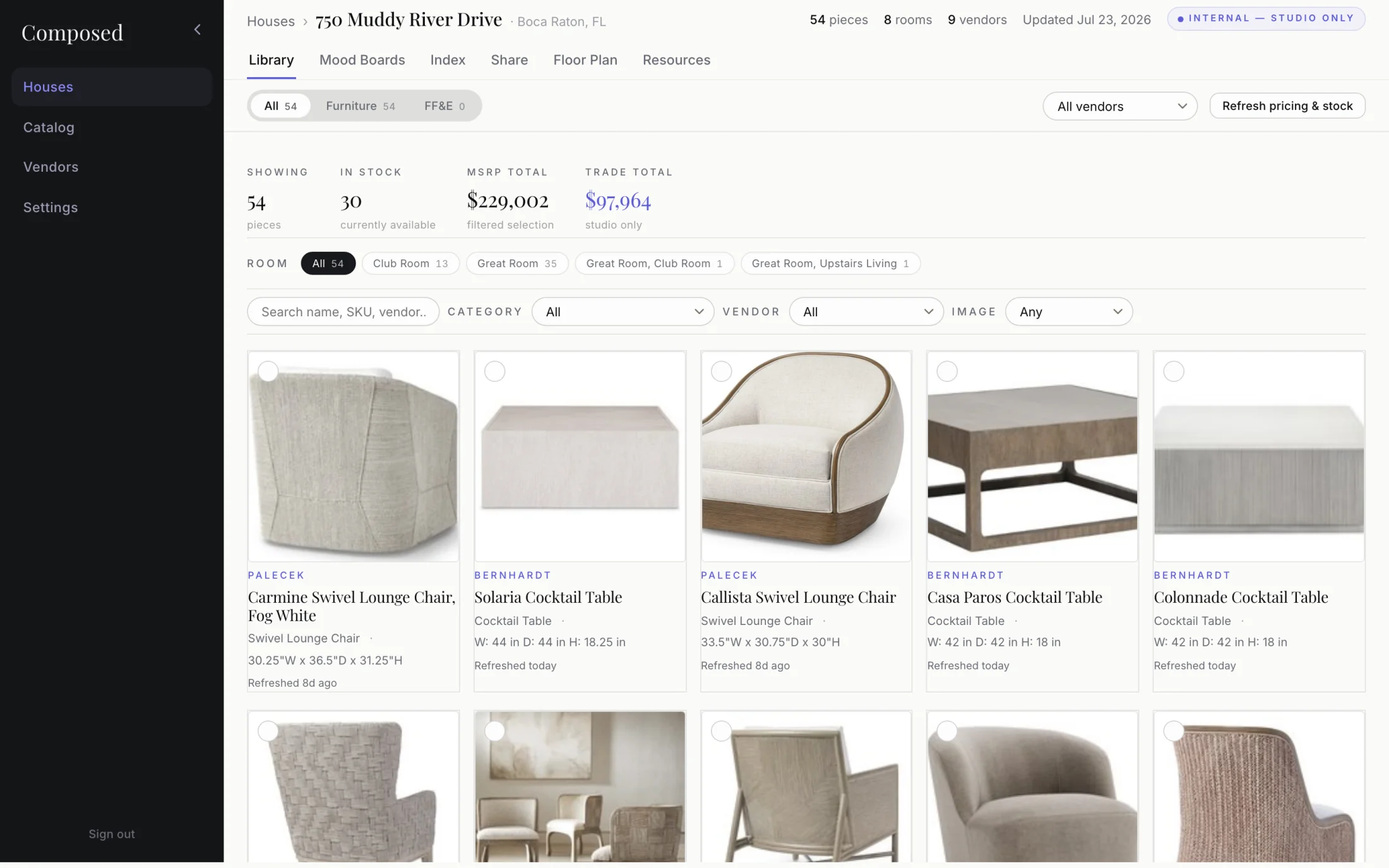
Every item you've specified stays current on its own: trade price, stock, lead time, and order status, read from your own vendor accounts. No catalog to maintain, no workflow to adopt. Composed fits the way you already run projects, and does the rest of the job when you want it: approvals, ordering, receiving, install.
Looking for one design partner: free access, hands-on setup, and a direct say in what gets built. See the offer.
"It has taken at least four manual workflows and put them into one application. It makes me look more professional, more put together. My client's first reaction was, 'compared to what we did before, this is amazing. I actually enjoyed this.' It was night and day."
Right now a single house lives in a dozen places: a pricing spreadsheet, an inbox full of vendor confirmations, a stack of PDFs, and a board somewhere else. Composed pulls all of it into one place and keeps the data current, so nothing catches you off guard in front of a client.
Availability, lead times, pricing, dimensions, and images stay current, and every item shows a "last refreshed" timestamp. Refresh one item, a whole vendor, an entire house, or the full catalog on demand. The discontinued piece shows up now, not on install day.
"If something is about to go out of stock, I can tell the client now — order it or we lose it — instead of finding out two weeks later."
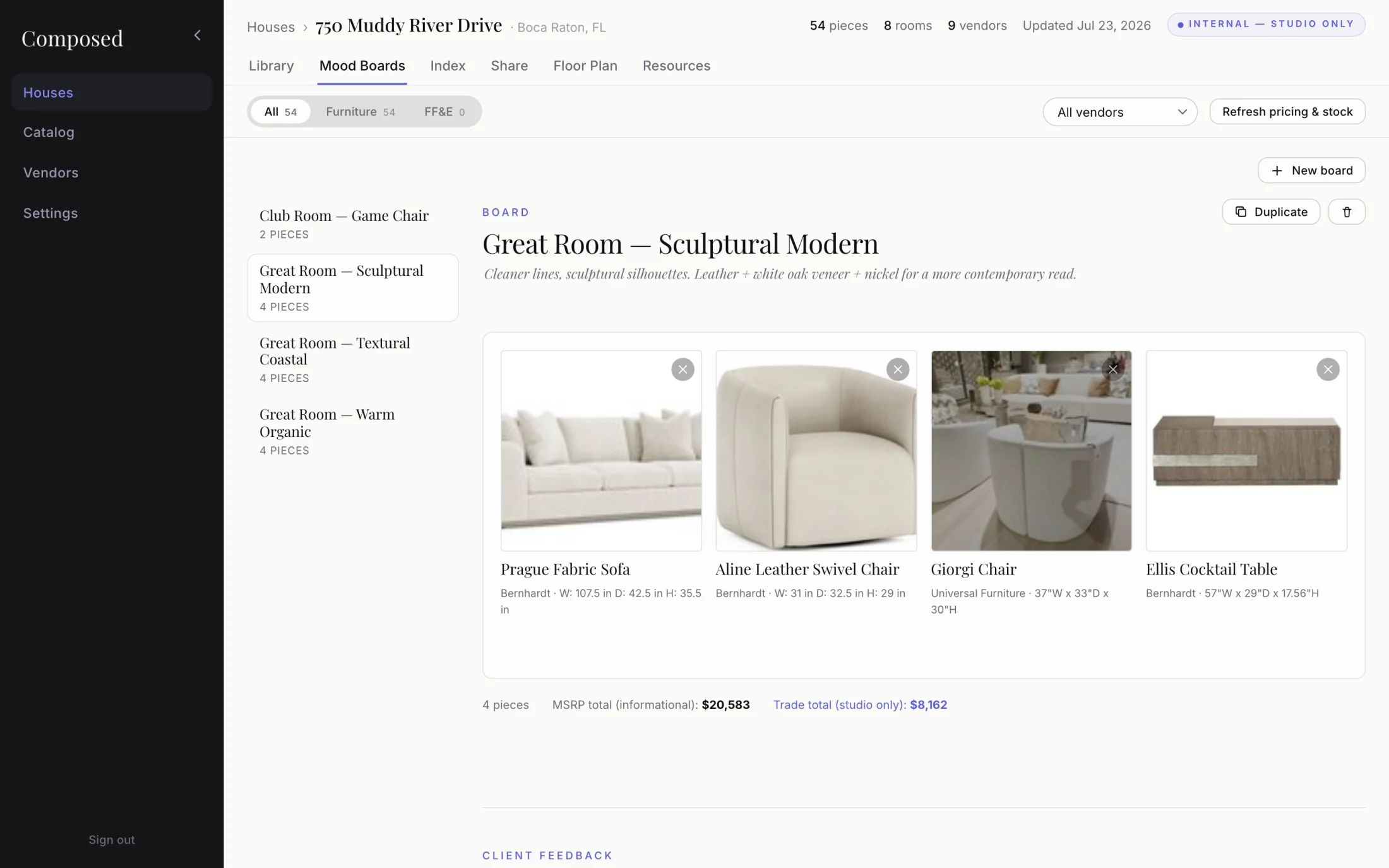
Paste a vendor URL and the product lands on your board, image and details pulled in for you. Try directions side by side, and every board totals itself: MSRP for the client conversation, trade cost for yours. Budget and margin move together as you design.
"I can source in real time and see how much I've spent in a room, and I can see my own margins too. Before, I didn't really look at the budget until the very end."
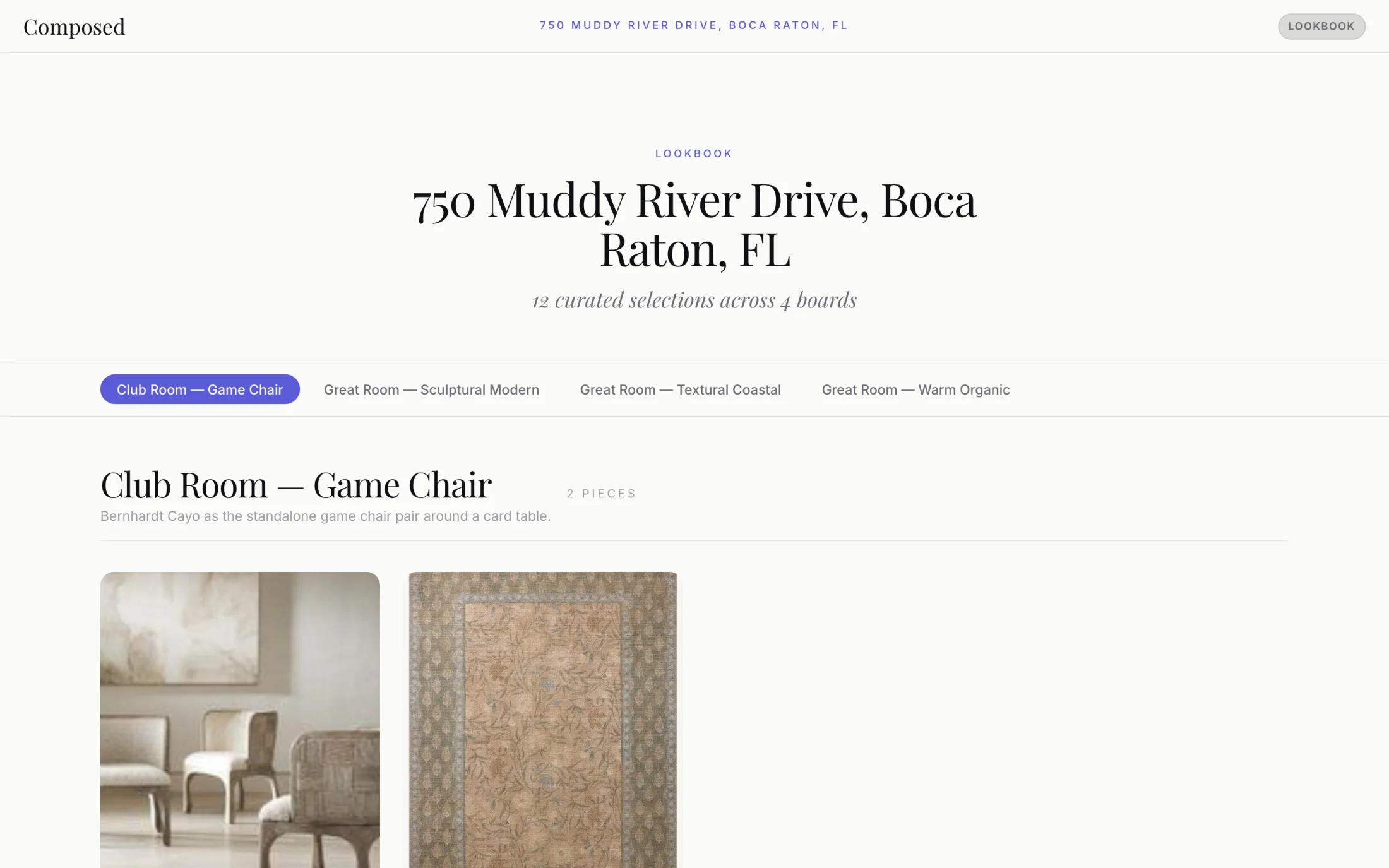
Send one link. Your client opens a clean, branded lookbook with no pricing columns, no SKUs, no app chrome. They react, comment, and sign off. It reads like your design work, because it is.
"Before, I was putting it on the client to imagine everything in their head. Now the board does that for them. I want my client to feel like it's easy to work with me."
Clean order sheets per vendor, and track what's ordered versus what isn't, even when half a room is already on its way.
Each hand-off shows only what that person needs: dimensions for the receiver, rooms for the installer, no pricing.
A flipbook view of just the selected pieces, full-bleed, for the moment the room comes together.
An abstracted, legible plan beside you while you curate, so you can see what goes where without leaving the board.
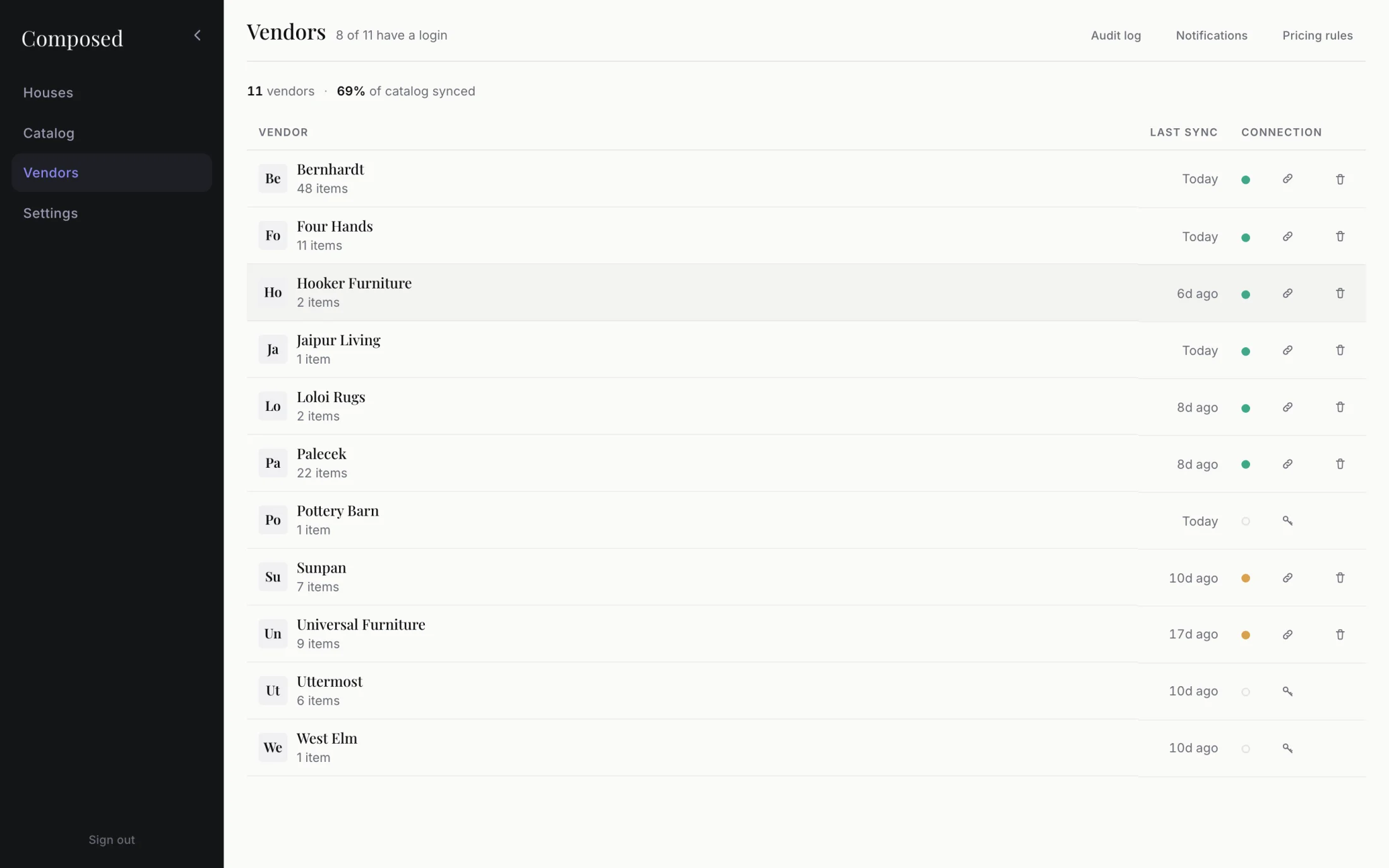
A house library, a mood board with live totals, vendor sync status, and the lookbook your client opens.
Ask a working designer what the tool is worth and the time saved comes second. The first thing is how it makes them look. New clients rarely leave over the design itself; they leave over friction, over a designer who feels hard to work with, or behind the times. Composed is built for both: the hours it gives back, and the impression it leaves in front of the people who hired you.
"The way people do business today is not an Excel spreadsheet. You send someone a 60-page Canva document nobody wants to read, and you feel antiquated, like you're stuck in 1990. People who hire a designer want someone creative, fresh, on the forefront. This makes me look like that."
Save a vendor login once and Composed signs in as your studio to read what a logged-out page hides: your trade price, real stock, real lead times. That's the built-in path, now in beta. Refresh runs right in the app, no browser gymnastics, one item or the whole catalog.
Then there's your concierge: a Claude skill on your own Mac, working in your own logged-in Chrome. It sees the numbers only your account sees, including vendors that reveal the trade price only after the piece is in your cart, where a signed-out cloud tool sees nothing but retail. Tell it what you need in plain language and it files the work into Composed. Non-technical? Setup is a skill install plus one connection step. You never touch code.
Vendors already supported include Bernhardt, Four Hands, Palecek, Universal Furniture, Pottery Barn, Uttermost, West Elm, CB2, Crate & Barrel, and Loloi.
Composed white-labels to your brand: the app you work in, the PDFs you export, and the share links your clients open. Type your website URL and Composed reads your studio name, fonts, logo, and colors to pre-fill a Brand Kit for you to review. Or paste a design prompt into Claude and get a ready-to-import brand back. One click activates it; "revert to default" undoes it. Minutes, not a white-label engineering project.
"Having my brand on it makes me look legitimate. When I go to a vendor, I want to look big. I want them to give me their biggest tier discount. Anything that legitimizes me is great."
I'm looking for one interior designer to build this out with. You run a real project in Composed, I wire up your vendors by hand, and we shape the product around how you actually work.
Takes about two minutes. Prefer to talk first? Book a walkthrough · hello@composed.design